

DIGITAL MARKETING GUIDE
Digital Marketing Guide: Understanding the Fundamentals of Digital Marketing
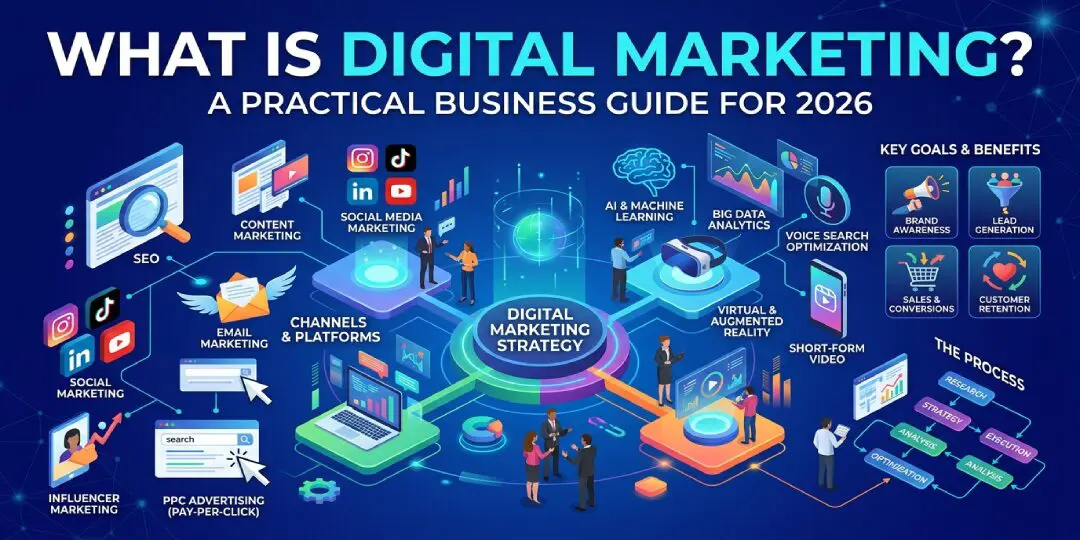
Digital marketing is often made to sound much more complicated than it really is. With terms such as SEO, social media, paid advertising, email marketing, analytics, and website optimization, beginners can easily feel that digital marketing is difficult to understand.However, the basic idea is quite simple. Digital marketing is simply marketing carried out through digital channels.This digital marketing guide explains the important concepts that can help you understand how digital marketing works, how to choose the right channels, and how different marketing approaches can be used to achieve business goals.
What Is Digital Marketing?
Digital marketing means promoting a product, service, business, or brand through digital channels.These channels can include search engines, social media platforms, paid advertising, email marketing, websites, and other forms of digital media.For example, when a business uses SEO to appear in search results, runs Google Ads, publishes content on social media, sends promotional emails, or improves its website to generate more conversions, it is using digital marketing.Traditional marketing, on the other hand, uses channels such as television, radio, newspapers, magazines, and billboards.Traditional marketing still has value, but digital marketing provides several advantages. Businesses can potentially reach a much larger audience, target specific groups of people, measure results, receive feedback quickly, and make changes while a campaign is running.
Why Is Digital Marketing Important?
This is a title
One of the biggest advantages of digital marketing is its ability to reach a large audience.Billboards, newspapers, and other traditional channels are often limited by location and distribution. Digital channels can potentially connect businesses with people across cities, countries, and even the entire world.However, reaching a large audience does not mean trying to reach everyone.A successful marketer needs to identify the people who are most likely to need or purchase the product or service. Digital marketing makes this type of audience targeting possible.For example, instead of showing an advertisement to everyone, a business can focus its campaign on a specific audience based on characteristics such as age, location, interests, or behavior.Digital marketing can also provide immediate feedback. An online campaign can be launched quickly, and marketers can monitor its performance through measurable data.This allows businesses to make corrections, test different ideas, and optimize campaigns without having to wait for weeks or months to understand whether their marketing worked.
Digital Marketing Guide: Strategy and Tactics
A major lesson in this digital marketing guide is the difference between strategy and tactics.Strategy is the bigger picture. It determines the direction of your marketing and provides the foundation for everything you do.Tactics are the specific actions used to execute that strategy.For example, deciding which social media platform is suitable for your business is a strategic decision. Deciding how frequently you should post on that platform is a tactical decision.Similarly, deciding that your target audience spends most of its time on Instagram is strategy. Deciding whether to publish Reels, images, stories, or other content formats is a tactical decision.Businesses often make the mistake of choosing platforms and tools before understanding their business, market, and message.A better approach is to build the strategy first and then select the tactics and channels that support it.
The Core Four of Digital Marketing
The strategy can be understood through four important elements: model, market, message, and media.
Model
The model represents the business itself.It includes the offer, pricing, packaging, service, and the way the product or service is delivered to the market.A business model should be designed around something that is valuable to customers, in demand, enjoyable to operate, and capable of generating profit.
Market
The market represents the people you want to serve.Instead of trying to target everyone, identify your ideal customer.This can involve understanding demographic information such as age, gender, income, and occupation.It can also include geographic information such as the city, state, province, or country where customers live.Psychographic information is also important. This includes values, attitudes, interests, lifestyles, and other factors that influence customer behavior.Understanding your ideal customer makes it easier to create relevant marketing.
Message
Your message is how you communicate with your target market.A strong message should address the customer's problems, frustrations, needs, and desired outcomes.Rather than simply talking about your business, you should explain how your product or service can help solve a specific problem.Customer stories, testimonials, case studies, and previous results can also make your message more convincing.
Media
Media refers to the channels where you communicate with your audience.This could include Google, YouTube, Facebook, Instagram, LinkedIn, email, websites, or other digital channels.The important point is that you do not need to use every available platform.You need to identify where your ideal customers are actually present and active, and then focus your marketing efforts there.This can save time, money, and energy while preventing your business from spreading itself too thin across channels that may not produce results.
Organic vs. Paid Digital Marketing
Another important part of this digital marketing guide is understanding the difference between organic and paid marketing.Organic marketing refers to content that you publish without paying the platform to promote that specific content.For example, posting on Facebook, creating an Instagram Story, publishing a YouTube video, or sharing other content without paying for distribution can be considered organic marketing.Organic does not necessarily mean that creating the content costs nothing. You may spend significant time, effort, and resources creating it. The important distinction is that you are not paying the platform to distribute it as an advertisement.Paid marketing works differently.With paid marketing, you pay a platform to distribute your advertisement or content to a selected audience.Examples include Facebook Ads, Instagram Ads, YouTube Ads, LinkedIn Ads, and Google Ads.Organic marketing can provide value without direct advertising costs but may have more limited reach. Paid marketing requires a budget but can help businesses reach a large, targeted audience much faster.Therefore, the choice between organic and paid marketing often comes down to factors such as time, money, reach, and the speed at which you want to generate results.
Direct Response vs. Brand Awareness
Digital marketing can also be divided according to the objective of the campaign.Direct response marketing focuses on getting a specific and measurable response.This could be a lead, sale, phone call, website visit, registration, free-trial signup, or another desired action.For example, a business may run a Facebook advertisement with the goal of generating leads. It can then measure how many people clicked the advertisement and how many eventually submitted their information.Brand awareness marketing has a different objective.Instead of focusing primarily on immediate conversions, brand awareness aims to build recognition, trust, authority, and familiarity over time.Both approaches can be important for a successful business.The key is understanding that a brand awareness campaign should not necessarily be judged using the same expectations as a direct-response campaign.Using the wrong marketing approach for the wrong objective can make a campaign appear unsuccessful even when it is doing exactly what it was designed to do.
Search Marketing vs. Discovery Marketing
Another important concept in this digital marketing guide is the difference between search and discovery marketing.The key factor here is intent.When someone uses Google or another search engine, they generally have a specific reason for searching.They may be looking for an answer, a product, a service, a solution, or information.This creates an opportunity for marketers to appear when that person is actively looking for something.SEO and pay-per-click advertising are examples of strategies that can be used in search marketing.Discovery marketing is different.On platforms such as Facebook and Instagram, people are often browsing content rather than actively searching for a product to purchase.Because of this, marketers need to capture attention first.Discovery marketing often requires creative, entertaining, educational, or engaging content that creates interest and encourages people to learn more.Search marketing can respond to existing intent, while discovery marketing can help generate interest.Both approaches can be valuable, but they require different messaging and creative strategies.
Practical Use of Digital Marketing
The practical use of digital marketing depends on the type of business, its customers, and its objectives.For a product-based business, digital marketing can be used to demonstrate product features and benefits.For example, if you are marketing a pen, you can show its design, explain its features, demonstrate how it works, and communicate the benefits those features provide.The feature is what the product has, while the benefit explains why that feature matters to the customer.Services require a somewhat different approach because they are intangible.A customer cannot physically see or touch a service before purchasing it. In many cases, customers also need to pay before experiencing the service.Therefore, marketing a service requires a strong focus on the final outcome.Instead of only explaining what the service includes, marketers should communicate the result or benefit that the customer can expect.For example, a digital marketing agency should not simply list the services it provides. It should explain how those services can help a business improve its online visibility, attract potential customers, generate leads, or achieve other meaningful outcomes.Testimonials, case studies, and previous customer results can help build the trust required to sell an intangible service.
B2B vs. B2C Digital Marketing
Another important concept covered in this digital marketing guide is the difference between B2B and B2C marketing.B2B stands for business-to-business. It refers to businesses that sell products or services to other businesses.B2C stands for business-to-consumer. It refers to businesses that sell directly to individual consumers.The marketing strategy can differ significantly between these two models.B2B marketing typically focuses on fewer but potentially larger customers. Because the value of each customer can be higher, businesses may need to provide stronger explanations, demonstrations, case studies, and proof before a purchase decision is made.B2C marketing generally deals with a larger number of individual consumers.This can require different messaging, creative approaches, offers, and customer journeys.Understanding whether your business operates in a B2B or B2C environment helps you determine how to approach your audience.
Recent Digital Marketing Updates
Digital marketing continues to evolve as platforms, technologies, and customer behavior change.One of the biggest developments affecting modern marketing is the growing use of artificial intelligence.AI is increasingly being used across marketing activities, including content creation, campaign optimization, audience analysis, personalization, customer communication, and other business processes.Search behavior is also evolving as search engines introduce more AI-powered experiences. This means marketers need to focus not only on traditional rankings but also on creating useful, relevant, trustworthy, and genuinely valuable content.Social and advertising platforms are also becoming increasingly automated. Businesses can use automated systems to improve audience targeting, campaign performance, creative testing, and customer interactions.However, technology does not replace the fundamentals of marketing.Understanding the market, identifying the right audience, creating a strong message, choosing the appropriate media, and measuring meaningful results remain essential.The tools may change, but the underlying principles of understanding customer behavior and delivering value continue to matter.
Digital Marketing Guide: Choosing the Right Approach
There is no single digital marketing strategy that works for every business.The right approach depends on your business model, target market, message, objectives, budget, and available resources.You may need SEO if your customers actively search for solutions.You may need social media if your audience spends significant time on discovery-based platforms.You may need paid advertising when you want to reach a targeted audience quickly.You may need email marketing when you want to maintain relationships with existing leads and customers.The important thing is to avoid choosing a platform simply because it is popular.Start with the customer and the business objective, and then work backward to determine which channel and tactic make the most sense.
Conclusion
Digital marketing does not have to be complicated.At its core, it is simply marketing through digital channels. The real skill lies in understanding the fundamentals behind marketing and applying them correctly.A strong digital marketing guide should therefore go beyond explaining individual platforms. It should help marketers understand their business model, identify their ideal market, create the right message, and select the appropriate media.You should also understand the differences between strategy and tactics, organic and paid marketing, direct response and brand awareness, search and discovery, products and services, and B2B and B2C marketing.The digital world will continue to change, particularly with the growth of AI and increasingly automated marketing platforms. But the basic principles remain the same: understand your customers, solve their problems, communicate your value clearly, choose the right channels, and measure your results.When these fundamentals are in place, digital marketing becomes much easier to understand and much more effective to execute.